Understanding Working Canine Behaviors

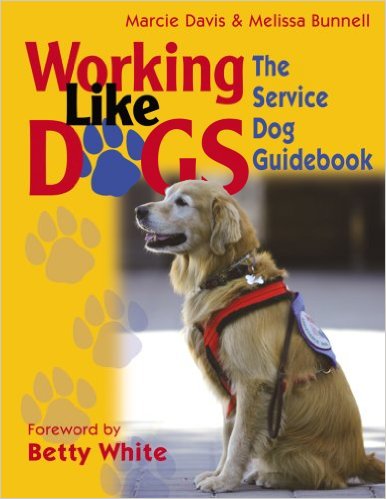
I had the opportunity to visit with veterinarian and pet behavior specialist Dr. Jeff Nichol (www.drjeffnichol.com) this week on our radio show, Working Like Dogs at www.petliferadio.com. Dr. Nichol brought up some interesting points about behavioral issues that working dogs can exhibit. Some of these hit really close to home for my current service dog, Whistle and past service dogs, Morgan and Ramona.
One of the issues that Whistle shows is excessive digging. Whistle loves to dig a huge hole in our yard. However, quite frankly, my husband and I are not too thrilled with this behavior.
I asked Dr. Nichol what his thoughts were on excessive digging in working dogs. He said that Whistle could be communicating a couple of things with his digging.
Perhaps one issue might be that he isn’t getting enough social interaction with other dogs. I found that really interesting because Whistle is on the go with me all the time and from my perspective, he gets plenty of social interaction. But, this is something I need to pay attention to. Dr. Nichol suggested taking Whistle to a dog park for some extra exercise and interaction with other dogs.
Secondly, he said that Whistle might not be getting enough exercise. Once again, from my perspective, he is on the go all the time and seems to get lots of physical activity throughout the day. Plus, he’s lean and is always full of energy.
I think energy might be the key here. Whistle is definitely a high energy dog. He is always ready to go to work and ready to play. I need to be more aware of his social needs to interact with other dogs and to get enough free, play time.
Dr. Nichol also talked about unruly barking and fearful behaviors such as aggression. Keeping Whistle healthy and happy is my priority. I learned a lot from my visit with Dr. Nichol and I look forward to future discussions with him about the behavioral issues that working dogs develop as they age.
Others Can Be Integral Parts of a Service Dog Team

I am always amazed at how respectful my husband, Franz, is regarding my relationship with my service dogs. He always has been. From the moment I received my first service dog and for the last seventeen years as I am now working with my third dog.
When I got my first dog, Ramona, he was instructed not to interact with her. For the first month, he was not even supposed to have any eye contact with her. I will never forget when I brought Ramona home. What a proud moment. And Franz was so supportive. He followed all the rules until one morning when I got out of the shower and found Franz and Ramona rolling around the living room floor playing together. They both looked at me as if to say, “We just couldn’t take it any longer.”
From the moment I received my first dog, Franz has never overridden or even tried to override a command that I have given. Quite the opposite, he remains silent whenever I need to communicate with my canine partner. And somehow he manages to do this in spite of the fact that each dog I’ve had completely adores him. They love nothing better than to play rough house with Franz when he comes home at the end of the day.
I have often wondered what my service dogs think about Franz? Is he another dog? Is he a member of their pack? Is he one of the pack leaders?
He is definitely the second most important person in their life. Whenever I am sick or unable to meet their immediate needs, Franz steps in for me. He knows all of their commands and fluently speaks their language and yet, he acquiesces to me each and every time when needed.
I view Franz as a secondary member of our service dog team. He is the unsung hero who gets up in the middle of the night to take my dog out. He cleans up our yard. He goes to the emergency vet with us in the middle of the night when my service dog is sick.
There are so many people out their like Franz who provide unwavering support to working dog teams. Through their dedication and support, we are enabled to function and to flourish as a successful working team. We often talk about puppyraisers and their contributions to creating these amazing service animals. Rarely, however, do we talk about these unsung heroes who help to maintain healthy and highly functional teams.
These individuals are our family members, spouses, attendants, friends, etc. who quietly stay in the shadows offering their support in times of need and with the mundane daily tasks that might not be too fun or glamorous. I want to take a moment to say thank you to these integral secondary team members for all that they do to support the success of working dogs and their human partners. Whistle and I salute you!
Assistance Dogs of the West – Pioneers in Service Dog Training Programs

Recently I got to visit with Carolyn Clark Beedle, Executive Director of Assistance Dogs of the West (ADW), on Working Like Dogs at www.petliferadio.com. Carolyn stopped by to talk about the work she and her staff and volunteers are accomplishing at ADW in Santa Fe, NM.
ADW has been around since 1995 and they provide trained service dogs to people with disabilities in order to increase self-reliance and independence. They are relatively a small to medium size assistance dog agency that places about 20 dogs a year to clients in New Mexico and other parts of the country.
One of the things I enjoyed most during our visit was learning about ADW’s innovative educational and vocational programs. These programs engage elementary, middle and high school students at young as 8, at-risk teenagers, juvenile detainees, and youth and adult student trainers with developmental and physical disabilities.
ADW is unique in working with these populations to become student trainers. Since 1996, ADW trainers have worked with students at Santa Fe, Albuquerque, and other Northern New Mexico schools and agencies to deliver the ADW School Assistance Dog Program curricula. These innovative programs are teaching participating youth and adults the importance of patience and leadership, how to give and receive love, the necessity for emotional self-control, and the value of encouragement. As students build a relationship with their assistance dog, students also gain an understanding of the challenges facing people with disabilities. They also learn about generosity and sacrifice when they present the assistance dog they have trained to the client.
The genius of these programs is that the student participants pay a program fee to enroll in these classes. However, ADW does offer some scholarships and financial assistance for those who want to participate but can not pay the fees. ADW generates critical income and the student participants gain valuable social and personal skills. It is a win/win situation for everyone involved.
I was also encouraged by ADW’s Self Training Program where clients can bring in their own dogs for evaluation and training. A client’s potential service dog (of any breed) is assessed for temperament and “interest” in doing the work. If the dog and client are accepted into the program, for a fee, they can work with ADW trainers for a minimum of 40 weeks. Graduates of the ADW Self Training leave the program with Public Access Certification and an identified set of skills to support each individual client.
Hats off to Carolyn and her team of staff and volunteers for the innovative work they are doing to train and place assistance dogs with individuals with various types of disabilities!
Barking Like A Dog

I don’t know about you, but I am starting to get Spring Fever. We just had over six inches of snow this past week in Santa Fe; however, I am already looking forward to the days of planting and the rewards of beautiful dessert flowers and fresh vegetables from the garden.
The other day, Franz, Whistle and I went to a local yard and garden store for their annual winter sale to buy some outdoor pots. We parked in the accessible parking space and as I was opening my van door, a man and his large St. Bernard dog strolled past our vehicle. Whistle was safely seatbelted on the back seat. He lept to his feet and barked like an untrained dog. I, of course, was shocked and appalled at his behavior and quickly commanded him to be “quiet.”
He immediately responded; however, the damage was done. My dressed service dog had barked at another dog in public! I was so embarrassed and asking myself, “How could such an intelligent, trained service dog like Whistle bark at a strange dog like that?”
Whistle and I are out in public almost every day and granted, this was a rare incident. However, it is still very concerning to me and I want to know if you’ve ever been in that situation before and what have you done to handle it.
Morgan, my retired service dog, never barked at other dogs. He simply ignored them whenever he was working. But Whistle, on the other hand, does pay attention to other dogs. I correct him but in the past, he has lunged toward another dog or forged incessantly in order to get closer to a strange dog.
He doesn’t do this every time he encounters another dog, but it happens enough to embarrass me and to make me a little uncomfortable about approaching other dogs. What is the protocol for meeting and greeting other dogs? How do you handle these canine situations? I can’t wait to hear your experiences and suggestions!
Dog Treats and Service Dogs

I have to say that I was so strict with my first dog, Ramona, regarding treats. The agency that trained her really frowned upon treats and instructed me that she needed to work for me based on praise rather than treats. It made sense because they argued that if her working was dependent on treats and let’s say, for example, that I had fallen out of my wheelchair and was not able to reach any treats and I needed her to get the phone. What would I do?
Therefore, I gave Ramona very few treats. When Morgan came along, he was trained by another agency with a different philosophy about treats. They felt treats could and should be used as a reward when appropriate. Morgan loved the treats but he was not as much of a “chow hound” as I lovingly referred to Ramona. She was a complete maniac for treats; but Morgan, although he loved them, was not as possessed and obsessed by the thought of a treat.
So, here I am with service dog number three, Whistle, still debating about how to effectively use treats. I keep pondering how often and exactly when should I reward him with a treat? Whistle loves treats more than Morgan, but he is not quite as obsessed with treats as Ramona.
Another big issue for Ramona and treats was her weight. Whenever I would give her treats, she had an almost immediate and noticeable weight gain.
Whistle, on the other hand, is very lean and muscular. I monitor his weight closely and although I have been giving him regular treats, he has maintained a healthy weight. However, the dilemma continues. How often should I give my service dog treats and when? I adore all of my service dogs and I want to be good to them, but is giving them treats being good to them or am I negatively impacting their overall nutrition? And second, what kinds of treats should I be giving them? Organic, meat, veggies, fruit, etc.?
I was trained to give Ramona minimal treats for a variety of reasons and I always felt guilty after she was gone for not lavishing more treats on her. As a result, I have been much more lenient with Morgan and even more so with Whistle. My philosophy is, if it doesn’t interfere with their work performance or their health, then it should be okay.
What do you think? How do you dispense treats and what kinds of treats do you give your service dog?