Service Animal Relief Areas at Airports

Have you traveled through an airport since the U.S. Department of Transportation required airports to install service animal relief areas? Whistle and I flew to Washington, D.C. last week. We traveled through the Chicago Midway Airport and Dulles Airport in Washington, D.C.
We had a three hour layover on the way to Washington, D.C. in Chicago. I was so disappointed to see that the relief area was outside the secured perimeter at baggage claim. My caregiver took Whistle out and they had to go through security. We asked security if they could come back through the line any faster and were told they would have to go through the normal line. This was awfully time consuming and even though we had a three hour layover, we barely made our next flight. The security line was extremely long.
On the way back, Dulles did have a fenced in dog relief area. However, it too was outside of the secured perimeter and requires handlers to return through security. Once we landed at Chicago Midway, the security line was so long that we felt my caregiver would not have enough time to take Whistle out to the relief area and return through the enormous security line.
We asked a TSA official and a Chicago police officer and they both informed us that she would have to return through the security line with Whistle. They made no attempt to assist us and they didn’t really seem to know what I was talking about when I asked about a service dog relief area.
What we needed was a TSA security escort as a reasonable accommodation to get Whistle to the relief area and back through security so we could access our gate in a reasonable amount of time. That’s not what we received.
Poor Whistle did not have the opportunity to relieve himself and he was desperate to go out once we landed in Albuquerque. The Albuquerque airport does not have a specific dog relief area either. There is a grassy area that is unfenced and located outside the security perimeter where he relieves himself. And of course, there are no baggies or readily available trash bins.
I am contemplating filing a complaint with all three airports regarding their lack of compliance with the Department of Transportation requirement. I do not like to file complaints but I fear if we don’t self-advocate, this lack of responsiveness will continue indefinitely. Have you had any airport experiences with service dog relief areas? Did you file a complaint?
Courthouse Dogs Help Ensure Justice is Served

Have you heard of a courthouse dog? They’re not legal experts, but these specially trained dogs are being used in the criminal justice system to help provide support for crime victims and their families, and even for social workers or other staff members.
Increasingly, courthouse dogs are being used in states across the country. Although they’re called courthouse dogs, these dogs often work not only in the courthouse, but in facilities like child advocacy centers. Courthouse dogs are typically therapy dogs; however, some of these working dogs may have more advanced training as assistance dogs and can even work as medical alert and response dogs.
Daisy is one example of an advance trained, assistance dog pulling double duty as a courthouse dog. I had the privilege of interviewing Lori Raineri and Cameron Handley about Daisy, and her role at the Yolo County, California Multi-Disciplinary Interview Center (MDIC) on Working Like Dogs at www.petliferadio.com (please feel free to listen in to their full interview).
Lori personally trained Daisy as her assistance dog. She loved Daisy so much that she felt compelled to share Daisy’s talents with others. Lori reached out to her local District Attorney, Jeff Reisig, about creating a courthouse dog program. Reisig loved the idea and connected Lori with Cameron, the director of the MDIC. Through their joint efforts, the Yolo County pilot courthouse dog program was born!
The program’s goal is to reduce the trauma a child goes through when dealing with the stresses of the criminal justice system. Daisy helps calm the children and others participating in the process. She also helps them begin to trust again and to start the healing process. For professionals in the system, Daisy provides some relief from the emotionally draining situations they deal with day after day.
Daisy is there at the Center to greet the children when they arrive, and if they want, she can be with them during interviews, medical exams, and in court. Daisy knows a large number of commands, even in multiple languages. She can do tricks to break the ice, but then gets down to business, just quietly being there, comforting the children and their families during a tough time.
You can listen to the complete interview to discover more about how this public-private partnership was developed, all the tasks Daisy performs, and even how this unique government worker commutes to the office. You can also get ideas about how you might be able to start a similar program in your community.
I was so impressed with the work Cameron, Lori and Daisy, are doing together. I hope you are, too. I was also excited to see that the International Association of Assistance Dog Partners (www.iaadp.org) are including a session on Courthouse Dogs at their upcoming Conference to be held September 25, 2010 in Seattle, Washington.
National Assistance Dog Week August 8-14, 2010

We are so excited about the upcoming 2010 National Assistance Dog Week. And, to celebrate this special week, we decided to create and to launch a new web site dedicated solely to National Assistance Dog Week (www.assistancedogweek.org). As an assistance dog lover and partner, it dawned on me a few years ago that assistance dogs needed recognition for the countless ways they enrich people’s lives. As a result, National Assistance Dog Week was born!
As I tried to imagine the perfect time of year for such a celebration, I reflected on growing up in the South where we experienced the “dog” days of summer every August. And, I thought what a great time that would be to celebrate these amazing dogs! So, the second week of every August is now National Assistance Dog Week!
This year, I am so excited that we had the opportunity to create a new web site dedicated to National Assistance Dog Week. I realized that many people and non-profit organizations don’t have a lot of time or resources to develop press releases, proclamations, and other plans. So, we thought we would help them out by creating a web site that would provide this information for FREE!
The site was created as a resource for individuals or organizations who would like to celebrate assistance dogs. Anyone can download free materials and templates to help them plan, organize and customize their own event(s). There are sample press releases, proclamations, ideas for events, and even a sample public service announcement. Everything is free for the taking.
There is even an opportunity to promote your local activity on the site. AND, there is a contest for the best event. You can enter your NADW 2010 event and win a special plaque and gift certificate.
In New Mexico, our Governor will be signing a proclamation declaring August 8-14, 2010 as Assistance Dog Week in New Mexico. We will also be holding an Assistance Dog Fair at Zoe & Guido’s on August 14 from 10:00am to noon. So stay tuned for more exciting information about the activities we’re planning.
National Assistance Dog Week and the new web site are all about raising awareness about how assistance dogs touch the lives of so many individuals with and without disabilities. Assistance dogs selflessly demonstrate their love and dedication 24 hours a day, 7 days a week. And, for one week out of the year, we have the opportunity to celebrate these amazing canine partners.
So have fun and PLEASE let us hear from you about how you plan to celebrate National Assistance Dog Week! Who knows, you just might win a prize for it!
Did you happen to catch “Through A Dog’s Eyes” on PBS?

I have been waiting all week to watch Through A Dog’s Eyes on PBS. It finally aired this evening and it was a beautiful documentary of a group of individuals with disabilities who were receiving their first assistance dog through the Canine Assistants program in Georgia. The program highlighted several individuals’ experiences at the training camp and for the first few months after they returned home with their new service dog.
The program reminded me so much of my own training experience almost 17 years ago when I was placed with my first service dog, Ramona, in a similar program. Similar to these individuals, I was so inexperienced and naïve to the nuances of living 24/7 with an intelligent dog.
The documentary took me back to my own first day at Team Training and the anxiousness I was feeling as I met the other participants with disabilities and the dozens of trained dogs that were available to be placed with us as our new service dog. I will never forget how the trainer opened a door and beautifully groomed young vivacious dogs began pouring into the room. They were the most gorgeous dogs I’d ever seen and they were full of boundless energy and excitement.
They ran free through the large open room, sniffing our wheelchairs and jumping on some of our laps as they explored every inch of the room. We all sat their dumbfounded, secretly wondering which dog might be going home with us. That first day was so exhilarating and daunting.
As the trainer prepared us for the next two weeks of training, she made a comment that has always resonated in my mind. She said, “Your new service dog is not a robot. YOU have to motivate this dog to work for you. It is up to you to build the bond and the trust that will enable you to be an effective working team.” Boy, was she right. I have often thought of that comment over the years as I have transitioned from one service dog to another. Each time, I’ve had to start all over again and build the respect and trust with each canine partner.
Each dog has been different and exhibited sensitivities to different environmental and emotional triggers. They have different ways of playing and relieving stress. It takes a significant amount of time for me to learn my dog’s individual preferences and needs.
Building a relationship with a working dog is a commitment. Rarely is it automatic. Like any solid relationship, it takes time, work, perseverance and commitment. But when you think about it, these attributes really apply to all of the healthy relationships that we as humans hope to have, and I think that rings even more true for our relationship with our service dogs.
Whistle and I turned a corner in our relationship when I truly became sensitive to his needs and desires. When I learned to listen and to trust Whistle, he learned that he could trust and depend on me. I was the one who fed him, toileted him and played with him. He sleeps in my bed and he looks to me when he gets nervous. He is a part of me just like my wheelchair is a part of me. We have a reciprocal relationship. I help him and he helps me.
As I watched these new handlers on the documentary work with their dogs for the first time, I was reminded of all the work, sweat, and yes, even some tears, which go into building this unique bond between the canine and human service dog team members. It is one of the most beautiful relationships I have ever had the opportunity to experience and to observe. I am so hopeful for these new service dog teams. If they can learn to trust each other and if they will work hard together, then they both are in for a life altering experience that knows (nose) no limits.
Whistle passed the recertification test!

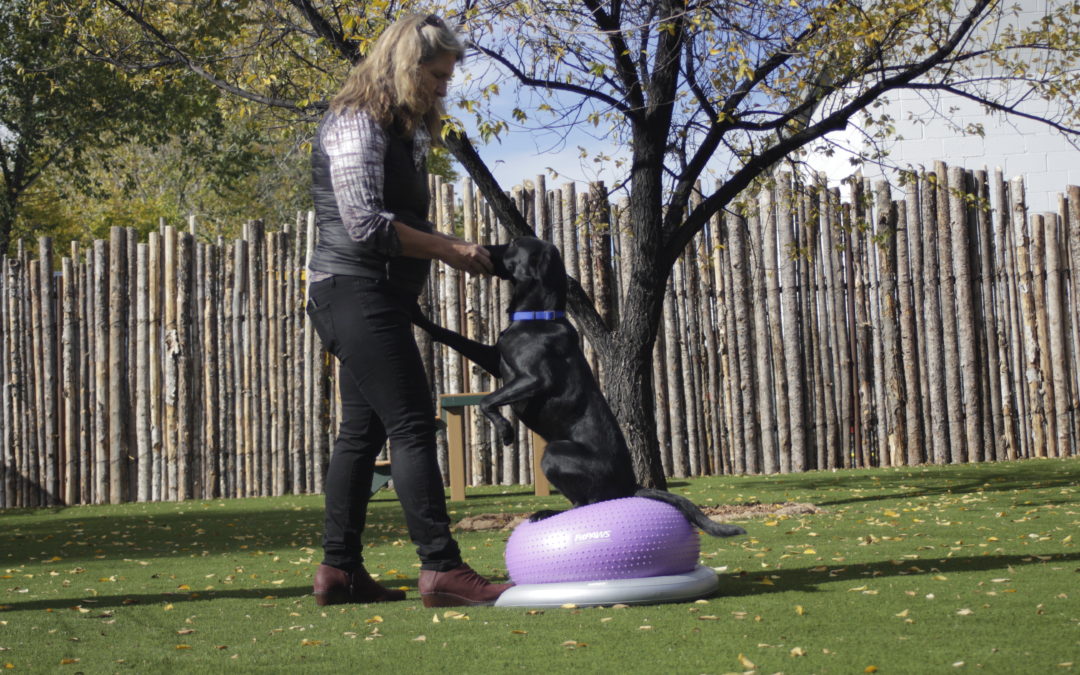
I am happy to report that Whistle completed his recertification requirements with flying colors! His Paws With A Cause field trainer, Dani, showed up at our house around 10:00 a.m. She had an array of paperwork that had to be completed. She asked all the usual questions about Whistle’s performance and overall wellness. After all the paperwork was completed, she enlisted my husband, Franz, to assist her by filming Whistle and me as we performed each command.
It was show time and Whistle and I began going through his repertoire of commands. We started with some of the simpler commands. Whistle was asked to perform a sit, down, and stay under Dani’s watchful eye while Franz captured the performance on video camera. We continued through the list of commands and finished with his most difficult command “Get Help”. In this task, Whistle is trained to locate Franz in our home and alert him that I need assistance. Once he alerts Franz, he is trained to return to me.
I don’t know why I was so nervous about Whistle’s performance? I guess I was nervous for Whistle. Or perhaps I was just worried that Whistle would pick up on my nervousness. I didn’t want him to think that I doubted his ability.
People always talk about the bond between a person with a disability and their service dog. It’s true, it is a unique bond that is difficult if not impossible to describe. I love Whistle so unconditionally that I wanted him to be successful. And yet, as I can only imagine how many parents feel, I couldn’t complete the test for him. He had to perform the commands. He was on his own, under the microscope and I was so afraid he might falter.
I have to say, I don’t’ know what I was worried about. I was blown away by Whistle’s professionalism and motivation. He genuinely loved working and it showed. He attacked every command with such precision. How could I ever have doubted his abilities? Whistle and I are together 24 hours a day, 7 days a week. Did I take his abilities for granted? Am I so used to his performance that I didn’t recognize it?
After Whistle completed all of his tasks in our home, we loaded up into my van and went to the local shopping mall. Once again, Whistle had to demonstrate his ability to perform each of his trained tasks but this time, he had to do it in public.
We arrived at the mall during the busy lunch hour. People were strolling around the mall looking for lunch and weekend bargains. Many people were beginning to stare as Whistle and I, along with Dani and Franz, huddled to discuss each task that Whistle would perform.
Once again, Whistle remained focused and deliberate as I asked him to perform each task. He ignored the onlookers and the food that was strategically placed in his path. Once again he performed flawlessly.
I have been partnered with a canine companion now for over 17 years and I am in awe of their unwavering dedication to us, their determination to help us, and the genuine pleasure they take in being by our side. I have said this before but I really mean it, I am the luckiest girl in the world to have the opportunity to live and work with a canine partner. They are truly amazing and they change the lives of their human partners in ways that can not be expressed or defined.
Whistle is officially recertified as a service dog for two more years. In two years, he and I will go through this exercise once again to demonstrate our ability to work together in public as an official Paws With A Cause service dog team.
After we said our good-byes to Dani, we returned home. Franz and I were so proud of Whistle. He had worked so hard and he had earned his recertification. We resumed our usual routine. I went back to work in my office and Whistle snuggled into his bed under my desk. After a few short minutes, I heard him snoring. He was curled up in a deep sleep, the poor guy was exhausted and I was elated.