Happy Birthday Morgan

May 1, 2011 · Posted in Service Dogs · 3 Comments 
Morgan

As many of you may know, Franz and I had to say good-bye to our beloved Morgan on March 12, 2011. Morgan was a golden retriever who proudly served as my second assistance dog. He came to us 11 years ago and brought with him a silent, soulful, intense presence that changed our lives forever.

Today would have been Morgan’s 13th birthday. And although he is gone, the light he brought into our lives will continue to shine as long as Franz and I hold his memory in our hearts.

I have always heard of selfless love and devotion and putting someone or something’s needs above your own. But I can now say that I experienced that firsthand through my relationship with Morgan. He truly loved his job as an assistance dog and relished spending every moment at home with his family. Morgan taught us the meaning of the words loyalty, tolerance and patience.

Not many people knew Morgan. He never won any international prizes or reached the summit of Mount Everest. He never expected or demanded any accolades for his selfless acts. He just wanted to be by my side making sure I was safe and content.

Morgan ended his life doing just that. Although his body was failing him and his eyesight and hearing were almost completely gone and his immunity system had completely shut down, he still took pride in dressing in his backpack every day and taking his post beside my desk in my home office. Even as we prepared him for his final journey to the vet’s office that fateful Saturday morning, he donned his backpack and proudly assumed the heel position on the left side of my wheelchair.

Being a service dog was Morgan’s first priority. It was his career. It was all he knew and all he wanted to know. Even as he drew his final breath, in his mind, he was still working. As we gathered around him to express our love and heartfelt good-byes, Morgan lay by my wheelchair with dignity and pride.

Dignity was important to Morgan. And, I take comfort in the belief that Morgan knew he had completed his job to the best of his ability. He had given unconditional love and devotion and his job was finally done.

Now, Franz and I are left with the memories and photographs of this special being. There is a tremendous void in our hearts and home. We miss him terribly but we are so thankful that this golden boy graced our lives. We can only hope that we will be worthy of his service and devotion as we carry his memory with us forever.

Happy Birthday my precious golden boy and thank you for all that you did and continue to do for me. You were an angel who blessed us with your presence for a short time. Unfortunately, you could not stay with us forever. It was an unspoken agreement we made with nature from the moment you arrived. And unfortunately, nature came to reclaim her prize.

Good-bye my dear, sweet boy and thank you from the bottom of my heavy, but joy-filled heart.

As the Mexian poet Octavio Paz stated, “Love is an attempt at penetrating another being, but it can only succeed if the surrender is mutual.” For me and Morgan, there was never a question that it was mutual love from the moment our eyes met.

A Research Study to Help Golden Retrievers

April 28, 2011 · Posted in Doggie Healthcare · Comment 

Golden Retrievers are commonly used as working dogs. My beloved assistance dog, Morgan, was a Golden Retriever and he suffered from many illnesses as he aged. That’s why I was so excited to read about a research study to help Golden Retrievers in the Cornell University College of Veterinary Medicine’s DOG Watch publication, Volume 15, No. 5 May 2011.

They reported that the start of a major study of cancer in Golden Retrievers was announced at the North American Veterinary Conference earlier in 2011 in Orlando, FL

The Canine Lifetime Health Project is a 13-year study that’s intended to analyze cancer in Golden Retrievers. The Morris Animal Foundation created the project to learn how to prevent cancer and other canine diseases by determining genetic, nutritional, and environmental risk factors.

They want to enroll 2,500 Golden Retrievers between the ages of two and seven. The project has already received support from animal health companies like Hill’s Pet Nutrition, Pfizer Animal Health and Merial.

If you’d like more information, please visit www.morrisanimalfoundation.org and click on the “Major Health Campaigns” link under the “Our Research” tab. I can’t wait to hear the outcomes of this study.

Fourth Annual AVCO/Merial National Service Dog Eye Exam

April 8, 2011 · Posted in Doggie Healthcare · Comment 

Don’t forget that the Fourth Annual AVCO/Merial National Service Dog Eye Exam event is coming soon! Registration started April 1 and qualified service animals throughout the United States, Canada, and Puerto Rico can receive free eye checks throughout the entire month of May.

Eligible animals must be actively working and certified by a formal training program or organization or currently enrolled in one. The certifying organization can be national, regional, or local. Other service animals such as horses, cats, etc., can participate as long as they meet the qualifications. For more information visit: www.ACVOeyeexam.org.

The registration form is to be available online starting April 1.

The AVCO/Merial National Service Dog Eye Exam event is a philanthropic effort generously provided to the Service Dog public by the board certified veterinary ophthalmologists of the American College of Veterinary Ophthalmologists.

The ACVO has teamed up with Merial the last several years to put on this event. They report that in 2010 the number of service dogs seen had more than doubled, with more than 3,200 dogs examined. Additionally the program saw an increase in the number of service horses examined. Not only were police horses examined in Louisville KY but the famous Golden Gate horse patrol benefited from ocular examinations. The event was featured on Good Morning America last year as well.

Have a story about your assistance dog and this event? The ACVO is asking you email your story to office11@acvo.org and include photos under 5MB if you have them.

I learned the importance of eye examinations several years ago when my retired service dog, Morgan, developed a degenerative eye condition and almost lost his eyes. Dr. Kennard, a veterinary ophthalmologist with Eye Care for Animals in Albuquerque, literally saved his eyes and his eyesight.

I called my veterinary ophthalmologist to register Whistle and to schedule his eye examination. I hope you will too!

U.S. Department of Justice Rules on Assistance Dogs to Become Stricter March 15, 2011

March 11, 2011 · Posted in Americans with Disabilities Act, Assistance Dogs · 10 Comments 
legislative session

James J. McDonald, Jr., managing partner, Fisher & Phillips, LLP wrote a good summary about the March 15 changes impacting U.S. assistance dogs. His summary is listed below. It’s long but I found it to be very informative.

Regulations issued in 1991 following the enactment of the Americans with Disabilities Act required that public accommodations (which include restaurants, hotels, retail establishments, theaters, and concert halls) modify their policies, practices, or procedures to permit the use of a service animal by an individual with a disability.

Essentially this means that service animals accompanying persons with disabilities have to be admitted to establishments with policies that otherwise exclude pets or other animals.

When the ADA was enacted, most service animals were “seeing-eye” dogs that assisted blind or sight-impaired persons. In most cases, these dogs were highly trained and, because of their extensive training, were not likely to create a nuisance or a sanitary problem.

Over time, however, a variety of species came to be characterized by their owners as service animals, including pigs, horses, monkeys, snakes, lizards, birds, and rodents. Also, dogs and other animals that merely provide emotional comfort to their owners also have been characterized as service animals.

This proliferation of creatures claimed to be service animals has posed obvious problems for many restaurants and hotels in terms of safety, sanitation, and disturbance of other guests. Until now, however, proprietors were largely powerless to bar these types of animals from their establishments.

The U.S. Department of Justice has issued new regulations effective March 15, 2011, however, which will substantially limit the types of animals that will qualify as service animals under the ADA.

First, only dogs (and miniature horses in some cases) will qualify as service animals under the new regulations. “Other species of animals, whether wild or domestic, trained or untrained,” will not qualify. The new regulations, however, do not place limits on breed or size of dog.

Second, the dog must be “individually trained to do work or perform tasks for the benefit of an individual with a disability, including a physical, sensory, psychiatric, intellectual, or other mental disability.” The regulations go on to state that the work or tasks performed by the service animal must be directly related to the handler’s disability. Examples of work or tasks set forth in the regulations include:

a. Assisting sight-impaired persons with navigation or other tasks
b. Alerting hearing-impaired persons to the presence of people or sounds
c. Providing nonviolent protection or rescue work
d. Pulling a wheelchair
e. Assisting an individual during a seizure
f. Alerting an individual to the presence of allergens
g. Retrieving items such as medicine or the telephone
h. Providing physical support and assistance with balance and stability to individuals with mobility impairments
i. Helping persons with psychiatric and neurological disabilities by preventing or interrupting impulsive or destructive behaviors

Under the new regulations, the mere “provision of emotional support, well-being, comfort, or companionship does not constitute work or tasks” for purposes of the definition of service animal. Thus, animals that provide only comfort or emotional support for their owners will no longer qualify as service animals.

For a dog to qualify as a service animal to an owner with a psychiatric disability under the new regulations, the dog must be trained to perform specific work or tasks. Examples given in the guidance accompanying the new regulations of tasks performed by psychiatric service animals include reminding the handler to take medicine, providing safety checks or room searches for persons with posttraumatic stress disorder, interrupting self-mutilation, and removing disoriented individuals from dangerous situations.

The guidance also states that a dog that is used to “ground” a person with a psychiatric disorder will qualify as a service animal if the dog has been trained: (1) to recognize that a person is about to have a psychiatric episode and (2) to respond by nudging, barking or removing the person to a safe location until the episode subsides.

The new regulations additionally clarify that “attack dogs” trained to provide aggressive protection of their owners will not qualify as service animals. The crime-deterrent effect of a dog’s presence, by itself, does not qualify as “work” or “tasks” for purposes of the service animal definition.

The new regulations also formalize prior Justice Department technical assistance addressing the use and handling of service animals. The regulations provide that a public accommodation may ask an individual with a disability to remove a service animal from the premises if the animal is not housebroken, or if the animal is out of control, and the animal’s handler does not take effective action to control it. (Ordinarily, the regulations state, a service animal shall have a harness, leash, or other tether, unless the person with a disability is unable to use a harness, leash, or tether or the use of such a device would interfere with the animal’s ability to perform its work or tasks.) If a service animal is removed for any of these reasons, the person with a disability must still be permitted to access the establishment’s goods, services, or accommodations without the animal being present.

The regulations also confirm that a public accommodation is not responsible for the care or supervision of a service animal.

The regulations provide that a public accommodation may not ask about the nature or extent of a person’s disability, but that it generally may make two inquiries to determine whether an animal qualifies as a service animal; it may ask: (1) if the animal is required because of a disability, and (2) what work or task the animal has been trained to perform. These inquiries may not be made, however, when it is readily apparent that the animal is a service animal, such as where a guide dog is guiding a blind person or a dog is pulling a wheelchair.

Furthermore, a public accommodation may not require documentation, such as proof that the animal has been certified, trained, or licensed as a service animal. Nor may a public accommodation require a person with a disability to pay a surcharge for a service animal, even if it applies such a surcharge for pets.

These regulations will not apply to landlords or airlines, which are governed by the Fair Housing Act and the Air Carrier Access Act, respectively. It is also not yet clear that these regulations, and particularly the definition of a service animal, will be applied by courts to cases brought under Title I of the ADA which covers employment.

A good argument may be made, based on existing case law, that a stricter standard would apply under Title I. Unlike under Title III, where a dog must be allowed onto the premises if it qualifies as a service animal and does not leave a mess or cause a serious disturbance, an employee under Title I of the ADA is entitled only to such accommodations as are necessary to enable him or her to perform the essential functions of the job.

An employee, therefore, will likely need to show that the presence of a service animal is needed for the employee to be able to perform his or her essential job duties. An animal that provides only comfort or emotional support to an employee, but that is not needed in order for the employee to be able to work, will not likely qualify as a reasonable accommodation under Title I of the ADA.

These new regulations give long-needed clarity to hotels, restaurants, retailers, and other public accommodations regarding which animals must be allowed as service animals, and under what circumstances. No longer will these establishments need to allow patrons to bring exotic, dangerous, disruptive, or unsanitary animals with them as purported “service animals.”

James J. McDonald, Jr. is managing partner of the Irvine, Calif. office of the national labor and employment law firm Fisher & Phillips LLP (www.laborlawyers.com).

Pseudo-Assistance Dogs Jeopardize Hard-won Rights for Real Service Animals

February 28, 2011 · Posted in Service Dogs · 10 Comments 
no dogs allowed

I saw a news item the other day in the New York Post about Hollywood celebrity Candy Spelling (mother of Tori and widow of TV producer Aaron) bringing her dog, Madison, a Wheaton Terrier, into a New York restaurant wearing a “service dog jacket.”

Is this dog really trained and certified as some type of assistance dog? I really have no way of knowing, but hearing about this incident just reminded me of how more and more I’ve been hearing about people trying to pass off pets as assistance animals.

I’ve even had friends ask to borrow my assistance dog’s backpack so they might be able to bring their pet to some event or into some business. I’ve always said, “Sorry, but no.”

It’s an image and reputation thing. If your pet has not gone through the rigorous training that “real” assistance dogs must obtain, he or she probably won’t be able to behave well enough in public. It’s hard for us who really rely on our assistance animals to condone your desire to have your pet with you everywhere. No matter how much you love them, you really don’t require them the way we do.

For over 75 years, Assistance Dogs have worked successfully in public and won the public’s acceptance by achieving high behavioral and training standards, which set them apart from pets and other animals. Assistance Dogs International, Inc. publishes minimum standards for assistance dog training programs to ensure the highest level of quality in assistance dog performance.

An ill-behaved “pretend” assistance dog gives all the real ones a bad reputation. If there are any incidents, it just makes people feel justified in denying access to a dog in the future, whether it is truly a trained assistance animal or not.

But it’s hard to know which dogs are “real” and which aren’t. If a business owner or someone else suspects that a dog is not really an assistance dog, but just a pet, what are they to do?

Not all people with disabilities are easy to visually identify. It’s not always people with guide dogs out there or those of us in wheelchairs these days. Think about the military veterans with PTSD and their dogs. Or those with hearing loss or autism. Can you tell if the man, woman or child with the dog is truly disabled and if their dog is truly an assistance animal?

What if a business owner confronts someone and they’re wrong? Or what if the customer makes a scene, even if their dog is really a pampered pet. Is the customer always right, no matter what?

People can train their own dogs, too, according to the Americans with Disabilities Act, so who certifies or decides which assistance dogs are genuine and which are fakes?

Here’s my fear: Passing your pet off as an assistance dog not only gives the real ones a bad image, it might jeopardize the hard-won rights of people who really need assistance dogs. If there are enough bad incidents, will someone try to enact legislation changing the access laws?

I remember back in the early 90s, three years after the ADA was enacted, when I got my first service dog, Ramona. I was stopped a lot and told things like, “You can’t bring that dog in here.” Nowadays I feel more confident traveling in my state and across the US, but I don’t want things to revert back due to the issue of pseudo assistance dogs.

This is a very real issue that I feel really needs to be discussed. I’d love to hear your thoughts.

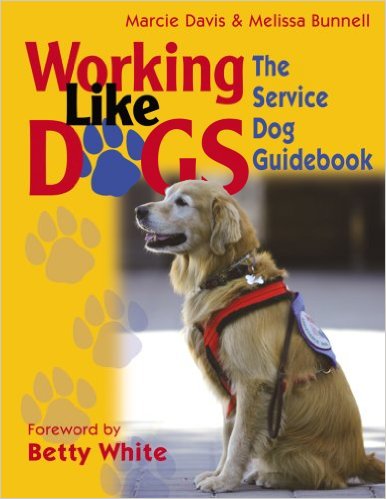
Here’s an article on the topic that just came out on Disability Scoop and another article from the Wall St. Journal. We discuss assistance dog standards in our book Working Like Dogs: The Service Dog Guidebook.

«More Recent Posts | Earlier Posts»